

How Long Does It Take to Learn to Surf? (Honest Answer)

Updated: Jun 17
Surfing is one of those sports where everyone wants to know: how long until I can actually do it? The honest answer is: it depends on what “do it” means to you.
Here’s a realistic, stage-by-stage guide.
Stage 1: Your First Wave (Session 1)
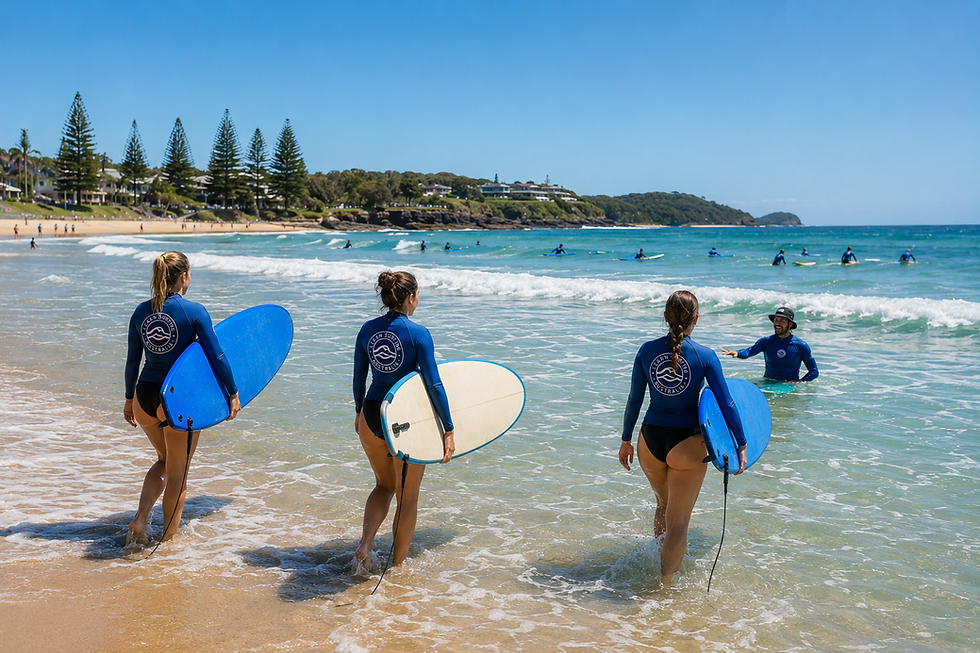
In your very first surf lesson, you will almost certainly catch a wave — and probably stand up on it. This surprises most first-timers. With a large foam board, good instruction, and consistent whitewash waves, riding your first wave is entirely achievable in a 90-minute lesson.
This is beginner surfing at its most forgiving. The whitewash (the broken, foamy wave after it has already broken) provides gentle, predictable push that allows beginners to experience the sensation of riding without needing to read or time an unbroken wave.
Milestone: First ride — Session 1
Stage 2: Consistency in the Whitewash (Sessions 2–10)
The next phase is about making the pop-up reliable. In early sessions, many beginners stand up successfully half the time, or fall sideways on the board. By sessions 5–10 with regular practice, most people develop a consistent pop-up, a stable stance, and the ability to ride whitewash waves to shore reliably.
This is also the stage where you start to understand the physics of wave-riding: how shifting your weight forward or back changes your speed and direction, how to angle your board, and how to read the shape of a whitewash wave before committing.
Milestone: Consistent whitewash rides — Sessions 5–10
Stage 3: Your First Green Wave (Sessions 10–30)
The transition from whitewash to unbroken green waves is where surfing becomes genuinely challenging. An unbroken wave requires you to position yourself correctly, paddle at the right moment, feel the wave lift and accelerate the board, and pop up before the wave breaks. The timing window is narrow and the consequences of mistiming (going over the falls or missing the wave entirely) are immediate.
For most beginners with regular practice, catching and riding green waves reliably takes between 10 and 30 sessions. The range is wide because it depends heavily on ocean conditions, the quality of instruction, how frequently you’re surfing, and your natural feel for the water.
Milestone: First green wave — Sessions 10–30
Stage 4: Reading Waves and Choosing Your Own (Sessions 30+)
This is where surfing becomes genuinely complex — and genuinely rewarding. Reading the ocean is a skill that takes years to develop. Understanding how swell period, wind direction, tide, and sandbars interact to produce the waves you’re surfing is a study that experienced surfers are still engaged in after decades in the water.
At this stage, the learning never really stops. It simply becomes richer.
What Speeds Up Progress?
Frequency. Surfing once a week produces much faster results than surfing once a month, even if the total number of sessions is the same. The body builds muscle memory more effectively with regular repetition.
Quality instruction. The difference between a good coach and a poor one can be months of progression. Specific, actionable feedback on your pop-up, stance, and wave selection dramatically shortens the learning curve.
Appropriate equipment. A beginner on a foam longboard will progress faster than a beginner on a shortboard. Volume and stability allow you to focus on technique rather than simply staying on the board.
Ocean fitness. Paddling fitness develops quickly but takes a few sessions to build. Beginners who arrive physically fit will have more energy to spend on surfing and less on simply getting through the paddle-out.

The Most Important Thing
Surfing is a lifelong sport. Most serious surfers have been in the water for decades and still find new things to learn. Approaching the early stages with patience and curiosity — rather than urgency — makes the whole process more enjoyable and, paradoxically, accelerates progress.
The beginner who commits to showing up regularly, getting proper instruction, and enjoying the process will out-progress the beginner who tries to rush.
Start your surfing journey the right way.
The LearnSurfing online course is built around the same progressive approach — practical, accurate, and designed for Australian conditions.
Explore the course at LearnSurfing.com.au

Comments